


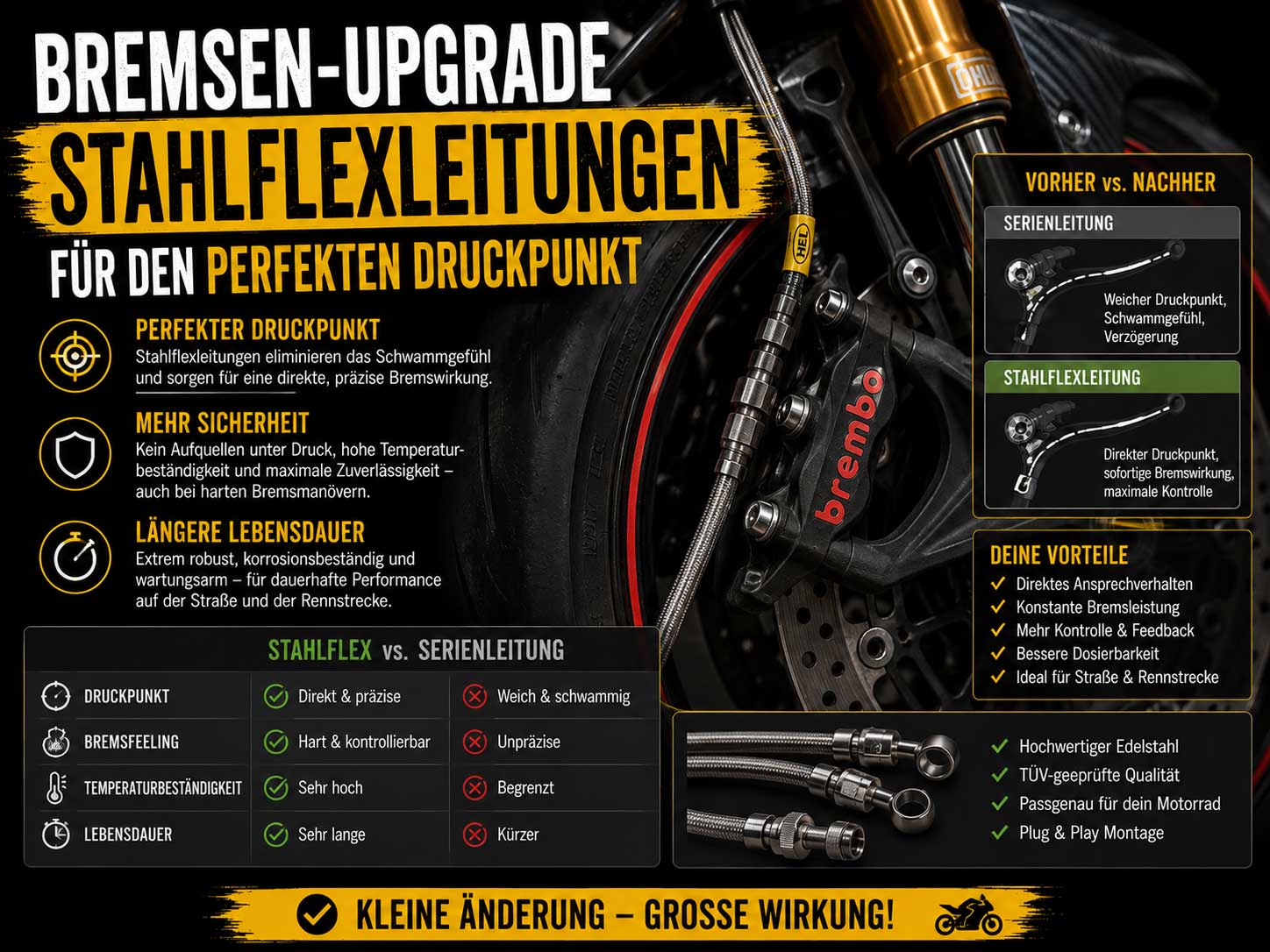
Brake upgrade - steel flex lines for the perfect pressure point
Brake upgrade - steel flex lines for the perfect pressure point
Who brakes later - is faster for longer
Do you know the feeling when you're approaching the next bend, pull the lever & the pressure point softens right at that moment? Nothing ruins your confidence in your bike faster than a brake that gives way when it really matters. Hard, precise anchoring decides milliseconds on the clock & your safety in the saddle.
The problem with original rubber lines - expansion & fading
Why is your brake weakening in the first place? It's quite simple. Most production bikes roll off the production line with conventional rubber cables. This rubber expands under pressure - and this occurs enormously during hard braking. If the temperature of the brake fluid rises during sporty riding, the material becomes even softer. The result is fading. Your braking force dissipates in the expansion of the line instead of acting on the callipers.
Steel flex lines - the guarantee for a constant pressure point
Put an end to the spongy feeling. Motorcycle brakes need clear messages. The core of steel flex lines is made of hard Teflon (PTFE), which is held in shape by a dense stainless steel mesh. There is exactly zero millimeter expansion. Your hand force is transferred 1:1 directly to the brake callipers. The pressure point remains hard as nails & exactly where it belongs.
Routing options on the front wheel - OEM routing vs. direct route
When converting, you basically have two options for routing the cables on the fork. Which option makes sense for you?
- OEM routing: This copies the manufacturer's original routing, usually with a distributor above the mudguard. Ideal for the road & a clean look.
- Direct route (racing routing): Here, two separate lines run directly from the brake pump to the two calipers. This saves weight, reduces sources of error & optimizes the flow.
Note for mechanics: Many of our radical parts for the racetrack are designed purely as racing products & are not road-legal. Before installation, check whether you want to ride the bike on the road or whether it will be a pure track tool.
The right accessories - racing brake fluid with a high boiling point
The coolest line is useless if your fluid boils. When upgrading, it is essential to replace the old fluid with fresh high-performance brake fluid. A high wet & dry boiling point (e.g. DOT 5.1 or special racing DOT 4) prevents the formation of vapor bubbles in the system. Remember to close the brake fluid reservoir properly, as this stuff is extremely hygroscopic and draws water out of the air.
Supplement with sintered metal or carbon-ceramic brake pads
Are you ready to go one step further? Combine the steel flex lines with more aggressive brake pads. Sintered metal bites hard in everyday use & in the rain. If you're chasing times, carbon-ceramic pads deliver maximum deceleration values at extreme temperatures.
Important tips for bleeding the system properly
Air in the system is the ultimate enemy. Once you have completed the conversion, bleeding the system is the difference between victory and defeat. Here's how to do it right:
- Lay out a cloth. Brake fluid attacks paint and plastic extremely aggressively.
- Always start at the caliper furthest away from the brake pump.
- Pump the lever, hold it down & then briefly open the valve. Close before the lever touches the handle.
- Switch on the head & keep an eye on the fluid level. If the pump draws air, start again.
One hundred percent confidence in the braking zone
The perfect setup frees your mind. You no longer think about whether the brakes will hold - you focus fully on the steering point. Steel braided lines are the upgrade with the best price-performance ratio when it comes to real feel. Convert, bleed cleanly & experience how much later you can drop the anchor.