


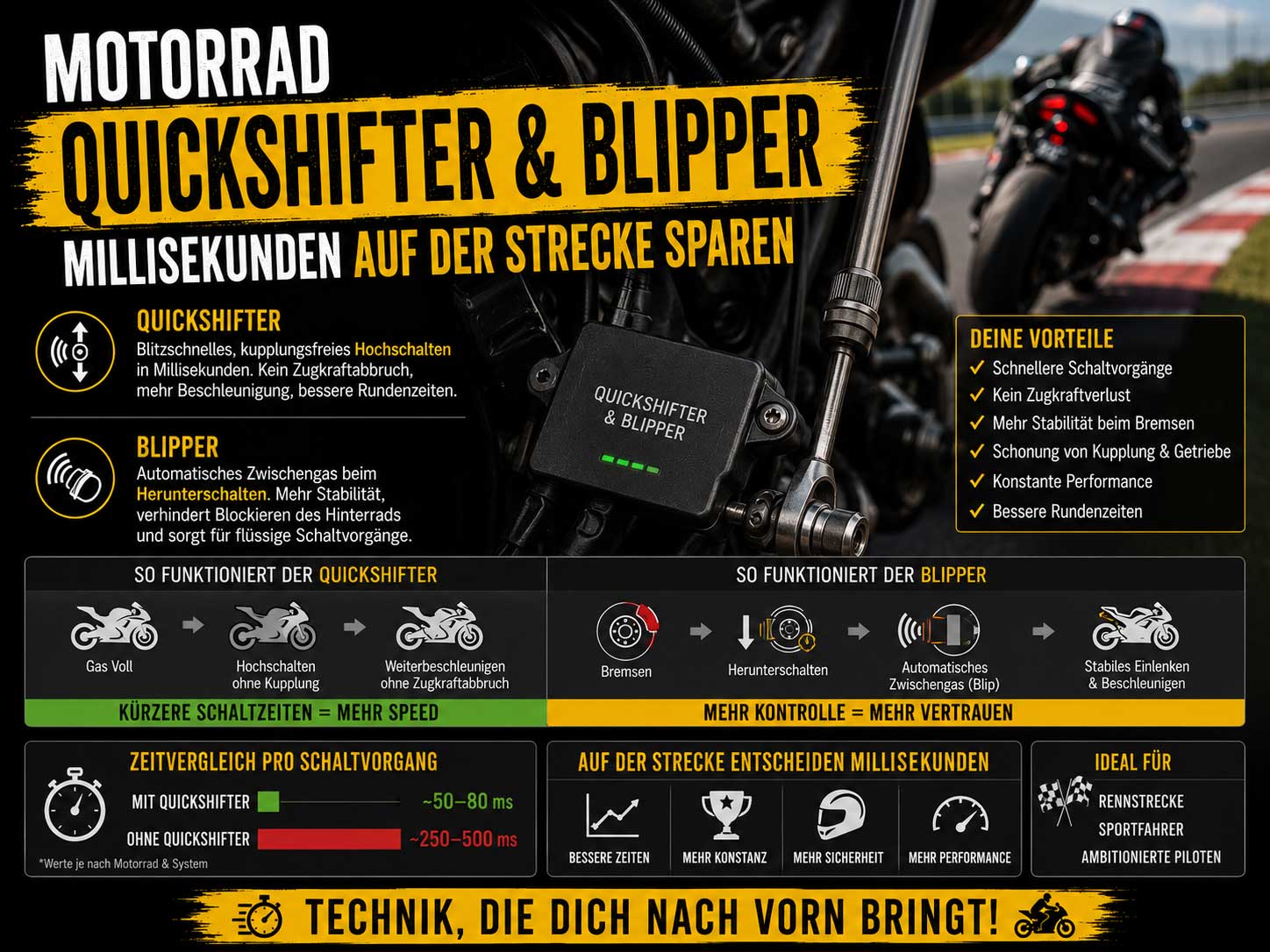
Quickshifter & blipper - save milliseconds on the track
Quickshifter & blipper - save milliseconds on the track
Fancy faster lap times & the ultimate racing feeling? If you want to tickle out the last tenths on the track, there's no getting around a quickshifter. Whether you're a trackday rookie or an experienced racer, this upgrade will completely change the way you ride. A quick note in advance: Many of these extreme performance parts are uncompromising racing parts & are not street legal. But it is precisely there, on the track, that they reveal their true potential.
Shifting under full load - pure acceleration without a clutch cable
Imagine firing out of a bend, the engine roaring & you simply push the gears in. No throttle release. No clutch. An automatic gearshift makes exactly that possible. You stay fully on the throttle & save crucial milliseconds with every shift. No interruption in traction means pure, relentless acceleration right up to the next braking point.
The basic technology - how a quickshifter interrupts the ignition
How does this magic actually work? Pretty smart. As soon as you tap the gearshift, the built-in sensor sends a signal directly to the control unit.
- The ignition or injection is interrupted for the blink of an eye.
- The transmission is load-free for a fraction of a second.
- The next gear slips in smoothly.
Immediately afterwards, full power is available again. You hardly notice a thing - apart from a tremendous, seamless drive.
What is an auto-blipper (downshifter) - how does the intermediate throttle work?
If the quickshifter is responsible for the merciless upshifting, the blipper (also called downshifter) takes over the downshifting. Without the clutch, of course, and with perfectly dosed intermediate throttle. The system recognizes the pressure on the gearshift as you approach the bend and automatically gives a tiny burst of throttle. The engine speed adapts exactly to the transmission speed. The gear engages without your rear wheel stamping dangerously.
The big advantage - time savings, less manual force & absolute silence in the chassis
Why do all lap time hunters swear by this setup? The hard facts speak for themselves:
- Maximum drive: you lose absolutely no speed & no revs when shifting up.
- Less hand force: Your left hand is massively relieved - a real blessing during long, strenuous stints.
- Absolute stability: No unstable chassis due to jerky clutch engagement or nasty load changes. Your bike is completely plush and stable when cornering.
Push or pull sensor - which sensor is needed?
This is where it gets technical, but simple. The choice of the right sensor depends solely on your shift linkage.
- Push sensor: Is required if your shift linkage is under pressure (compressed) when the next gear is engaged.
- Pull sensor: Is used when your lever pulls on the linkage.
So check briefly on the bike how your linkage moves before you order. Clever premium systems nowadays often also offer sensors that combine both (push & pull) in one component.
Reverse shifting (GP shift) - why racers have first gear up
Have you ever wondered why professionals shift gears the other way round? With the reverse shift (GP shift), the first gear is at the top and all other gears are pushed down. The reason for this makes a lot of sense on the track: in brute lean angles, you simply can't get your foot under the lever to shift up. With the reverse shift, you press it from above. Boom, next gear in without your boot dragging hard on the asphalt.
Requirements for retrofitting - older vs. modern bikes
Will the cool stuff fit your bike? Mostly yes, but there are crucial differences. Modern bikes with e-gas (ride-by-wire) often already have the necessary connections or even pre-installed electronics for blippers. On older motorcycles with a classic throttle cable, a normal quickshifter (only for upshifting) can usually be adapted without any problems. However, a genuine auto-blipper for downshifting on these models often requires more complex additional modules, as the system has to take over the intermediate throttle mechanically.